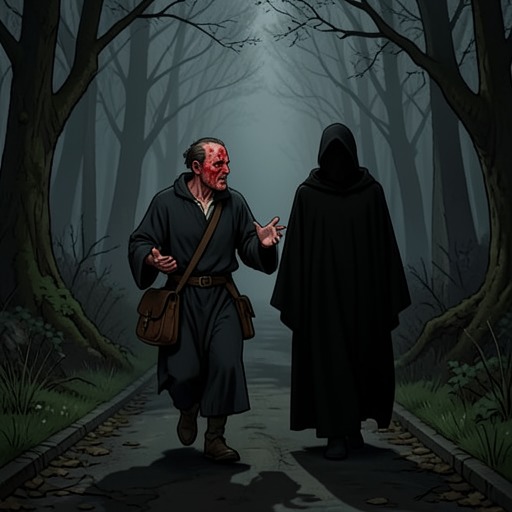
The summoner's pact with the devil
The Canterbury TalesThe summoner's pact with the devil marks the moment when institutional corruption acquires a supernatural counterpart. A summoner, whose work is already associated with extracting money through false summonses, meets a disguised fiend while riding through the countryside. Their agreement makes explicit the exchange governing his livelihood: the summoner will pursue acquisitions among the living, while the devil will claim his share. The episode’s decisive irony is that the summoner believes he is entering a practical partnership, whereas the partnership reveals the damnation already implicit in his conduct.
The Summoner’s Trade and Its Setting
The episode begins with the summoner riding out to summon an old widow whom he intends to rob, carrying false summonses for that purpose. The intended victim is not presented as someone seeking justice but as a vulnerable person whom the officer can exploit through the appearance of legal authority. His office therefore operates as a commercial racket: the summons is a tool for turning fear of ecclesiastical proceedings into payment.
On the road, the summoner encounters a carefree yeoman beside a forest. The yeoman bears a bow and bright, keen arrows, giving him the appearance of an ordinary forester or bailiff. The summoner does not openly identify himself as a summoner, since the name itself would expose the shame attached to his occupation. When the stranger addresses him as a fellow bailiff, the summoner accepts the social convenience of the disguise. Their meeting thus begins through concealment, with professional resemblance masking a radical difference between a human extortioner and a supernatural predator.
The Pact and Its Terms
The supposed yeoman eventually declares that he is a fiend whose dwelling is in hell and that he rides about soliciting. The revelation transforms the earlier scene without changing its basic logic. The devil does not need to invent an alien method of action; he can join the summoner because both already understand acquisition as the taking of another person’s property or distress.
The two agree to act as brothers in their common business. Each will take a share of whatever people give them, so that both may live; if one receives more than the other, the surplus is to be divided. The language of fraternity and equal partnership gives the arrangement a surface of fairness, but its substance is mutual exploitation. The summoner’s proposed brotherhood is not founded on affection, service, or trust. It is a contract of collection, organized around what can be extracted from victims and how the proceeds will be apportioned.
The pact also reveals the summoner’s inability to recognize the moral meaning of his own practice. He treats the fiend as a useful associate because the devil’s activity resembles his own. The supernatural disclosure therefore functions less as a sudden intrusion than as a judgment made visible: the summoner has chosen a mode of life whose natural companion is hell.
The Widow’s Curse and the Pact’s Reversal
The arrangement reaches its decisive turn when the summoner attempts to profit from the widow. She resists him and curses both the devil and the pan he is carrying. The curse is not merely an expression of anger. It becomes the speech act that determines what the devil may claim. The summoner has relied on official language—summonses, threats, and demands—to convert words into worldly pressure; the widow’s spoken curse answers that coercive language with a forceful declaration of her own.
When the devil hears the curse, he addresses Mabel as his mother and responds to the terms contained in her words. The scene makes the pact’s hidden condition plain: the devil can take the summoner only when the victim genuinely wills his removal. The summoner’s fraudulent authority cannot protect him from the consequence of the curse, because the power he has used against others is turned back upon him through a morally intelligible utterance.
The reversal is especially sharp because the summoner began the journey intending to rob an old widow with false documents and ends by losing himself through her resistance. His planned seizure of another person’s goods gives way to his own seizure by the devil. The pact that seemed to promise shared profit thus becomes an instrument of damnation, and the victim’s curse supplies the immediate cause of its fulfillment.
Religious Satire and Moral Significance
The episode belongs to the broader satire of clerical corruption in which religious offices are measured against the behavior of their holders. Elsewhere, confession can be heard sweetly and absolution granted pleasantly, while a friar may pay for an exclusive begging territory, a philosopher may spend whatever he acquires from friends on books, and a pardoner may turn spiritual pardon into a commodity. Against these varied forms of religious economy, the summoner represents the coercive end of institutional power: he uses legal procedure as a pretext for extracting money from the defenseless.
His pact with the devil makes that economy legible as a system of exchange. The summoner expects payment from those he summons; the devil expects a share; the widow is treated as the source of revenue; and the final cost is the summoner himself. What appears to be a business agreement is therefore a moral ledger. The officer has converted spiritual jurisdiction into avarice, and the story answers by converting his avarice into literal service to hell.
The event also contrasts genuine religious care with counterfeit authority. A priest may listen to confession and absolve sin, whereas the summoner uses accusation and fear. A pardoner may claim that a holy pardon saves people from avarice even while exposing his own hypocrisy; the summoner’s case is harsher because his fraudulent practice directly victimizes a poor widow. His damnation gives narrative form to the principle that corrupt spiritual power is not spiritually neutral: it aligns the corrupt official with the fiend whose work he imitates.
Narrative Role and Ending
As an embedded moral exemplum, the pact joins comic disguise, professional fellowship, threat, and sudden supernatural justice. The devil first appears in the familiar clothing of a yeoman, and the summoner’s readiness to trust the disguise shows how little distinction he makes between lawful office and predatory opportunity. The final recognition does not redeem him or permit a negotiated escape. Once the widow’s curse is heard and accepted, the partnership’s true beneficiary is revealed.
The summoner’s damnation is consequently both an ending and an interpretation of the whole episode. The story does not present hell as an arbitrary punishment appended to an otherwise ordinary career. It shows the summoner’s everyday business already shaped by the same appetite that governs the fiend. His pact merely gives that appetite a visible partner, while the widow’s curse brings the concealed alliance to its inevitable conclusion.